
Puyallup Directory Runs by Year
The Washington State Library directory inventory gives the clearest verified list of Puyallup city directory holdings. It is a shelf map, not proof that every year was published. State Library access changed in 2025: general public access closed because of funding loss, while limited Thursday afternoon appointments remain available by email. The Puyallup Public Library History Room provides the most local alternative, though staff currently retrieve its materials because direct room use is unavailable.
| Collection | Years | Where Held | Access |
|---|---|---|---|
| Puyallup directory volumes | 1882; 1884-85; 1887; 1889-98 | Washington State Library | Catalog and limited onsite appointment |
| Puyallup directory volumes | 1915-16; 1947; selected 1950-65 years | Washington State Library | Catalog and limited onsite appointment |
| Puyallup directory volumes | 1967-86; 1988-90 | State Library, with possible local overlap | Verify each volume before visiting |
| R.L. Polk Puget Sound directory | 1887 | Canadiana digital collection | Free digitized scan route |
| Directories and high school yearbooks | Early 1900s onward, exact local run unstated | Puyallup History Room | Reference staff retrieval |
Publishers are not identified for every listed volume. Only the 1887 regional volume is verified as R.L. Polk & Co. The breaks before 1915, through much of the mid-century, and in 1987 mean that “not found” is weak evidence. A household may appear in a Tacoma or Puget Sound regional book, a yearbook, a newspaper, or a census even when no Puyallup volume survives for that year.
Puyallup History Room Access
The Puyallup History Room holds city directories, Puyallup High School yearbooks, historical images, and works by local residents reaching back to the early 1900s. The room itself is currently unavailable for direct use. Ask second-floor reference staff to retrieve an item. The main library at 324 S. Meridian is open Monday, Tuesday, and Thursday from 9 a.m. to 7 p.m.; Wednesday from noon to 7 p.m.; and Friday and Saturday from 9 a.m. to 5 p.m.
The library's History Room page shows the local collection and current access notice.
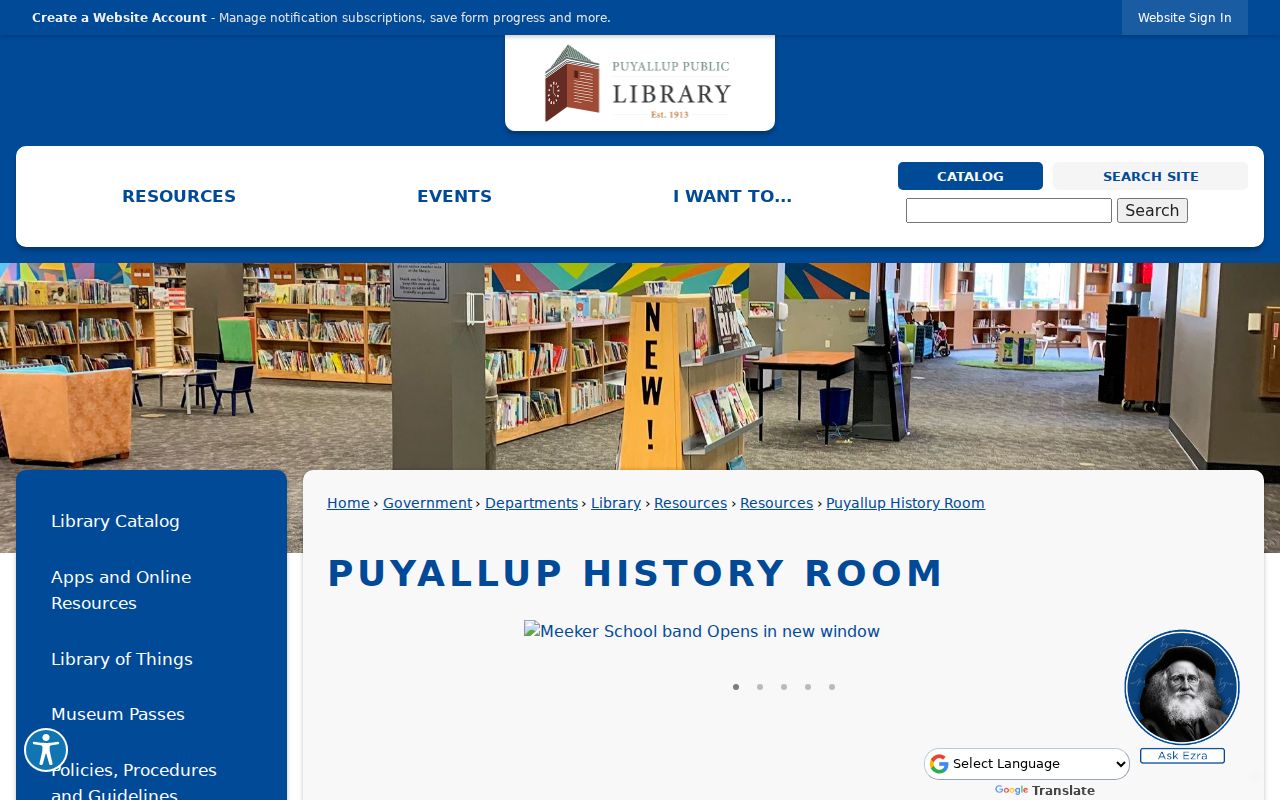
The captured page confirms why a call to 253-841-5454 before a visit can save time: staff-mediated retrieval, rather than open browsing, is the present access channel. Ancestry Library Edition is also available on library computers or Wi-Fi, and America’s News includes the Puyallup Herald and News Tribune.
Puyallup's First Reading Room
Puyallup’s directory story starts before its modern library building. Local library roots reach to Eliza Jane Meeker’s reading room in the 1860s. A formal library room followed in 1909, the library was established in 1913, and the current building opened in 2002. That long local chain explains why the History Room holds more than bound lists of names. Images, resident-authored books, school records, and early community documents can clarify an entry that uses an initial, an old business name, or an abbreviated street.
This history also supplies a practical method. Ask for material by year, surname, school, street, and format. Staff may find a city directory beside a yearbook or clipping collection that resolves the same-name problem. A catalog miss does not prove the item is absent, since some holdings are described as a group rather than as individual volumes.
Note: Record the title page and abbreviation key with each entry so later comparisons retain the publisher, year, and local context.
Reading Puyallup Directory Entries
The 1887 R.L. Polk & Co. Puget Sound directory is the one verified digitized regional volume that expressly includes Puyallup. Its bibliographic record confirms the publisher and date, but the research capture did not expose a full local entry page. Treat the field list below as an inspection checklist, not a transcription of one named resident. Later digitized Puget Sound directories show the broader pattern: alphabetical names, occupations, addresses, ads, schools, churches, and civic groups.
| Name | Surname, given name, and sometimes a middle initial or household marker |
|---|---|
| Household detail | Spouse, widow, boarder, or lodger notation when the volume supplies it |
| Work detail | Occupation, business, or employer, which can separate people with the same name |
| Place | Street or rural address, city section, and directional abbreviation |
| Other sections | Business listings, advertisements, institutions, churches, and schools |
- Criss-cross directory
- A later directory arranged by street and house number rather than by surname. Its presence must be checked volume by volume.
- Householder index
- A list centered on the person associated with a household, which may omit other people at the same address.
- Abbreviation key
- The volume's own legend for shortened occupations, relationships, street terms, and status marks. Read it before interpreting initials.
An entry establishes dated directory evidence, not title or a complete family relationship. Check whether an address is a home, shop, farm, boarding place, or office. Puyallup’s agricultural and fairground setting put growers, merchants, transport workers, and civic groups into the same books, so occupation and street should be read together.
Digital Puget Sound Directories
The Seattle Room digital directory collection adds regional examples with decade browsing, full-text search, highlighted hits, and page navigation. It should not be mistaken for a complete Puyallup run. Use it to learn how regional volumes are structured and to test whether a Puyallup person or business appears within a wider Puget Sound edition.
The digitized collection opens a searchable directory interface with regional volumes.
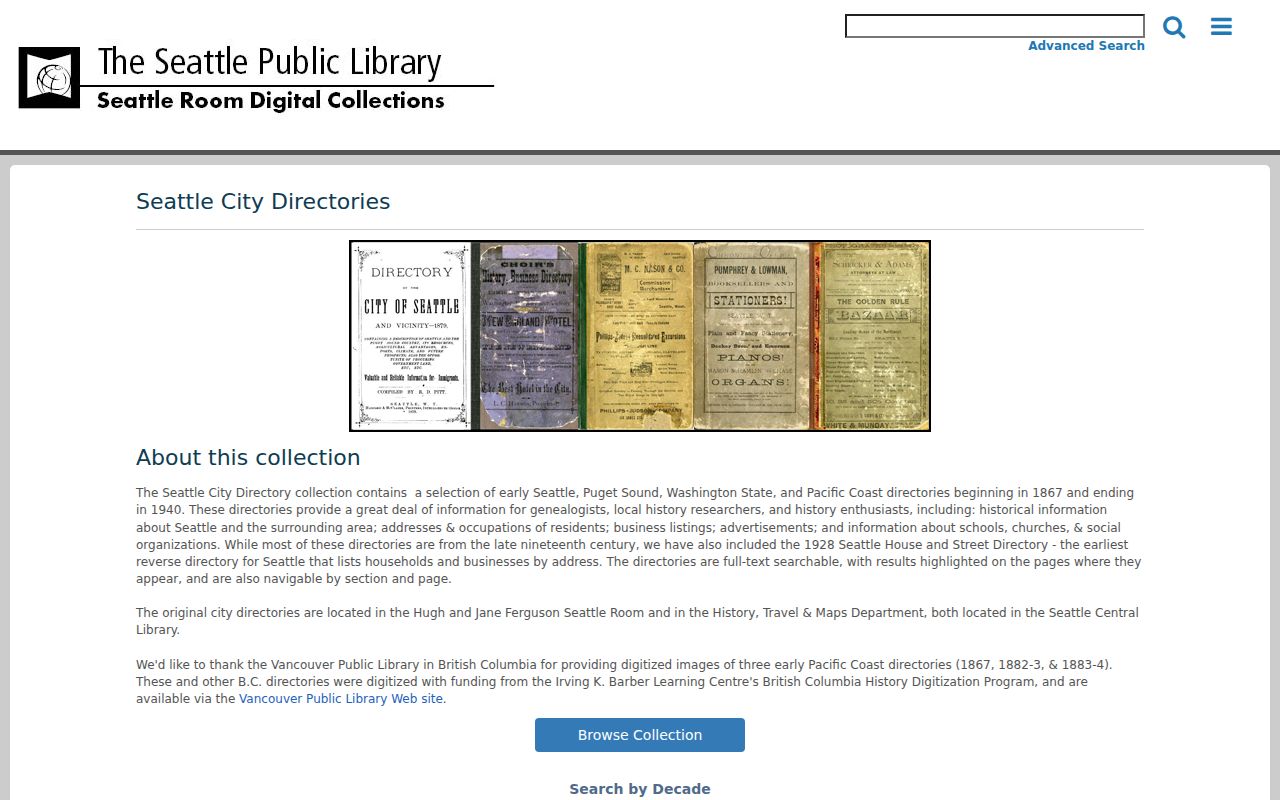
The screen is useful for finding a hit, but save the page image and title data together. Optical character recognition often misses initials, old type, and split columns. Browse adjacent pages when a full-text search fails.
Puyallup Directories Meet Old Maps
A street entry becomes stronger when it matches a dated map. The Library of Congress has a free, public-domain nine-sheet Puyallup Sanborn map from February 1900. It shows building footprints and uses. The 1915 Kroll atlas Puyallup sheet shows additions, lot and section numbers, roads, town limits, schools, churches, cemeteries, and some landowner names.
Neither map proves who lived inside a structure. Instead, use the directory name and street to find the site, then compare the map’s lot, addition, or building type with deeds and census records. Early searches should also try “Puyallup Valley,” township or precinct labels, and historical spelling variants because today’s city name and limits did not govern every old index.
Note: A mapped landowner, a directory householder, and a census resident can be three different people, so cite each source for its own claim.
Trace Families in Puyallup Directories
Family research works best as a dated sequence. The rich 1889-1898 run can show short moves and changes in work, while the nearly continuous 1967-1986 and 1988-1990 holdings can trace a later household in much finer steps. Scattered years must be bridged with census schedules, deeds, newspapers, and school sources.
- Find the closest available year using the State Library inventory or History Room. Search the full surname plus initials and spelling variants.
- Move forward and backward through actual held years. Log the address, spouse or household mark, occupation, and city section exactly.
- Check the street or business section if that volume includes one. Do not assume every Puyallup directory has a reverse index.
- Pair the directory entry with a released federal census schedule through the library’s Ancestry access or an archive, while accounting for changing boundary labels.
- Test the result against a deed, obituary, probate file, yearbook, Sanborn sheet, or Kroll lot. Keep a source date for every match.
A disappearance has several possible causes: a move, death, unlisted household, missed publication, regional inclusion, or a simple gap in the surviving shelf. Library newspaper databases may supply a dated obituary, wedding notice, school event, or business change. Historical marriage evidence can also be searched through the Washington Digital Archives Pierce marriage collection, which covers 1889-1947 and 1984 to the present for indexed marriage certificates, with separate application and agreement runs.
Puyallup Valley Family Archives
The Pierce County Historical Documents Survey searches collection descriptions across repositories. It can point to photographs, maps, plats, clippings, diaries, correspondence, oral histories, and architectural drawings. Contact the named repository for access because the survey is a discovery catalog, not one digital archive.
For a Puyallup family, Meeker Mansion and the Puyallup Historical Society offer a strong local lead. State archival inventories identify Meeker Family Records from the 1870s through the 1930s, Puyallup Valley business records from 1854-1880, and pioneer-family material. The society is at 312 Spring Street, phone 253-697-9468, with self-guided tours Wednesday through Sunday from noon to 4 p.m. Archive access should be confirmed separately from tour hours.
These sources add context that a city directory cannot carry. A family file may explain a business name, subdivision, plat, or civic role, but any claim about residence still needs a dated directory, deed, census, or other record.